Most hotels say they want more direct bookings, but they still act like OTAs and metasearch are the only way to be discovered. In 2026, there is a faster, more scalable way to get direct hotel bookings: make your property one of the first options AI systems feel safe recommending when travelers ask where they should stay.
This hotel direct bookings strategy is built around one core idea: turn your hotel into the obvious answer for AI search and assistants, so they keep sending you high-intent guests directly to your website. Everything else, including your website, profiles, reviews, and offers, is engineered to support that.
Executive Summary
One Simple Strategy to Get More Direct Hotel Bookings
In 2026, the fastest way to get more direct hotel bookings is not to add more channels. It is to make your hotel the obvious recommendation for AI-powered search and assistants. When you build AI visibility into your core strategy:
- You attract high-intent guests who discover you through organic search and AI answers, then click through to your website instead of an OTA.
- You turn your website and profiles into machine-readable proof of who you serve best, so AI systems know exactly when to recommend you.
- You steadily grow your share of direct bookings over 90 days and beyond, without matching OTA ad spend or slashing your rates.
What AI Visibility Means for Hotels (And Why It Drives Direct Bookings)
AI visibility is what determines whether your hotel shows up when a traveler asks ChatGPT, Google AI Overviews, or another assistant: "Where should I stay near [landmark]?" or "Best family hotel in [city]?" It is not about gaming an algorithm. It is about making your property so clearly described and consistently represented across the web that AI systems feel confident recommending you.
When AI tools recommend your hotel, the guest arrives at your site already primed. They are not browsing options on an OTA. They came specifically because something pointed them to you. That shift in intent is what makes AI-driven traffic convert into direct bookings at a meaningfully higher rate.
The hotels that win the most direct bookings in 2026 will not be the ones spending the most on ads. They will be the ones AI tools feel most confident recommending.
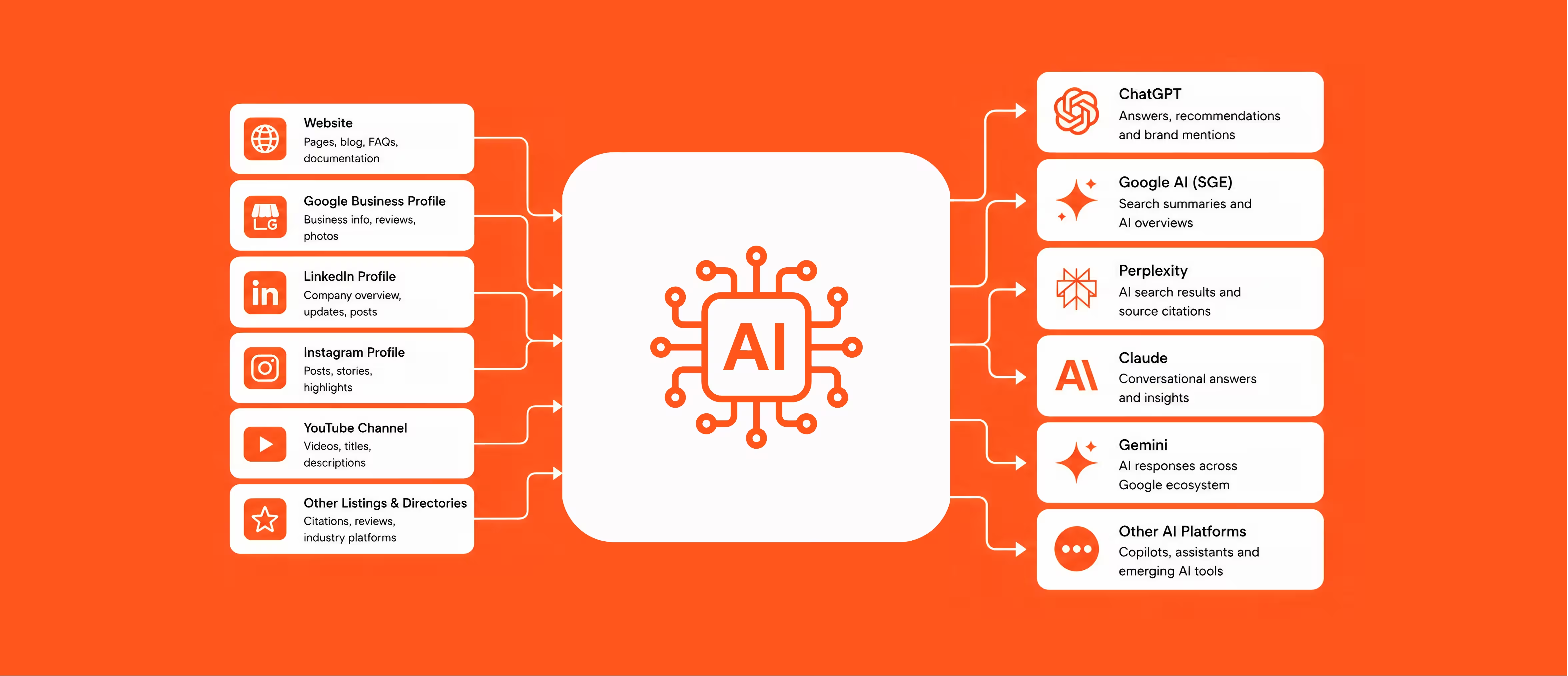
AI visibility is built from three types of signals: how clearly your website describes who you are and who you serve, how consistently your profiles across the web reinforce that description, and how strong your reviews and third-party content are as proof that you deliver on your promise.
If you want to see how visible your hotel currently is across AI-driven search and recommendation platforms, we offer a free AI Visibility Audit for hotels.
Step 1: Make Your Hotel Easy for AI to Understand
The first part of this strategy is making your hotel machine-readable, so search engines and AI agents do not have to guess who you are and when to recommend you.
Clarify your positioning on your website
Your website should answer, in the first screen:
- Where are you? (city, neighbourhood, nearby landmarks)
- What type of hotel are you? (business, boutique, family, resort)
- Who are you best for? (conference guests, couples, families, digital nomads)
Practical changes to make right now:
- Use a clear H1 like: "Business Hotel near [Convention Center] in [City]" or "Family-Friendly Boutique Hotel in [Neighbourhood]."
- Add a short sub-headline that spells out your core promise: "Walk to [venue] in 5 minutes, with fast Wi-Fi, quiet rooms, and early breakfast."
- Create dedicated pages for Rooms, Location, and Experiences, each with explicit, scannable information.
The more specific and structured this is, the easier it is for AI systems to match you to the right queries.
Add structured data so machines do not have to guess
Beyond visible text, you want your site to speak a language machines understand. Key moves:
- Use hotel-specific structured data (schema) to mark yourself as a Hotel or LodgingBusiness.
- Include in that structured data: full address and geo-coordinates, amenity highlights (Wi-Fi, breakfast, parking, pool, meeting rooms), aggregate rating and review count, and links to key pages (rooms, rates, booking).
This does not change what guests see, but it makes it far easier for AI-powered systems to read and represent you correctly and confidently.
Keep your key profiles consistent
Your website is your hub, but AI tools also lean heavily on trusted third-party profiles. Focus on:
- Your Google Business Profile.
- Major directories or local tourism sites.
- High-authority travel profiles where you are already present.
Align all of these with your website: same name, address, and phone number; matching descriptions with the same focus and guest types; and updated photos that reflect what your current experience actually looks like. If three different sources describe you in three different ways, AI will hesitate to recommend you.
Step 2: Use Reviews and Content as Proof You Are the Best Match
Once AI can understand you, it needs evidence that you are the right answer for specific types of travelers.
Turn reviews into targeted proof points
Reviews are more than a rating. They are signals about who you serve well. Encourage guests (without scripting them) to mention:
- The type of trip (business, family with kids, solo travel).
- What worked well for their context: quiet rooms, early breakfast, late checkout, proximity to certain venues, kids' facilities.
- Any standout service moments that made the stay memorable.
You can prime this by gently asking: "If you leave a review, it really helps if you share what kind of trip you were on and what you liked most." Include a short prompt in your review request emails. Over time, patterns like "great for conferences at [center]" or "perfect for families visiting [attraction]" become clear to both humans and AI engines.
Answer travel questions with specific, local content
AI tools increasingly pull from web content that looks like a direct answer to a traveler's question. You can create that content. Useful examples:
- Where to Stay Near [Convention Center] in [City]: 3 Types of Hotels and Who They Are For.
- Is [Neighbourhood] in [City] Good for Families? What to Know Before You Book.
- Best Areas to Stay in [City] for First-Time Visitors (With Walking Times and Transit Tips).
On each piece, talk honestly about pros and cons of different areas, explain clearly when your hotel is the best fit and when it is not, and include a call to action that leads to an aligned offering, like a business, family, or weekend package. This content gives AI agents something concrete and trustworthy to quote and link to when travelers ask similar questions.
Step 3: Turn AI-Driven Discovery into Direct Bookings
AI visibility puts you in front of the right people. Your site and offers turn that attention into direct revenue.
Make your book-direct benefits impossible to miss
If a traveler clicks from an AI-driven result to your site and sees the same rates and no extra value compared to OTAs, they will default to what is familiar. On your homepage and booking pages:
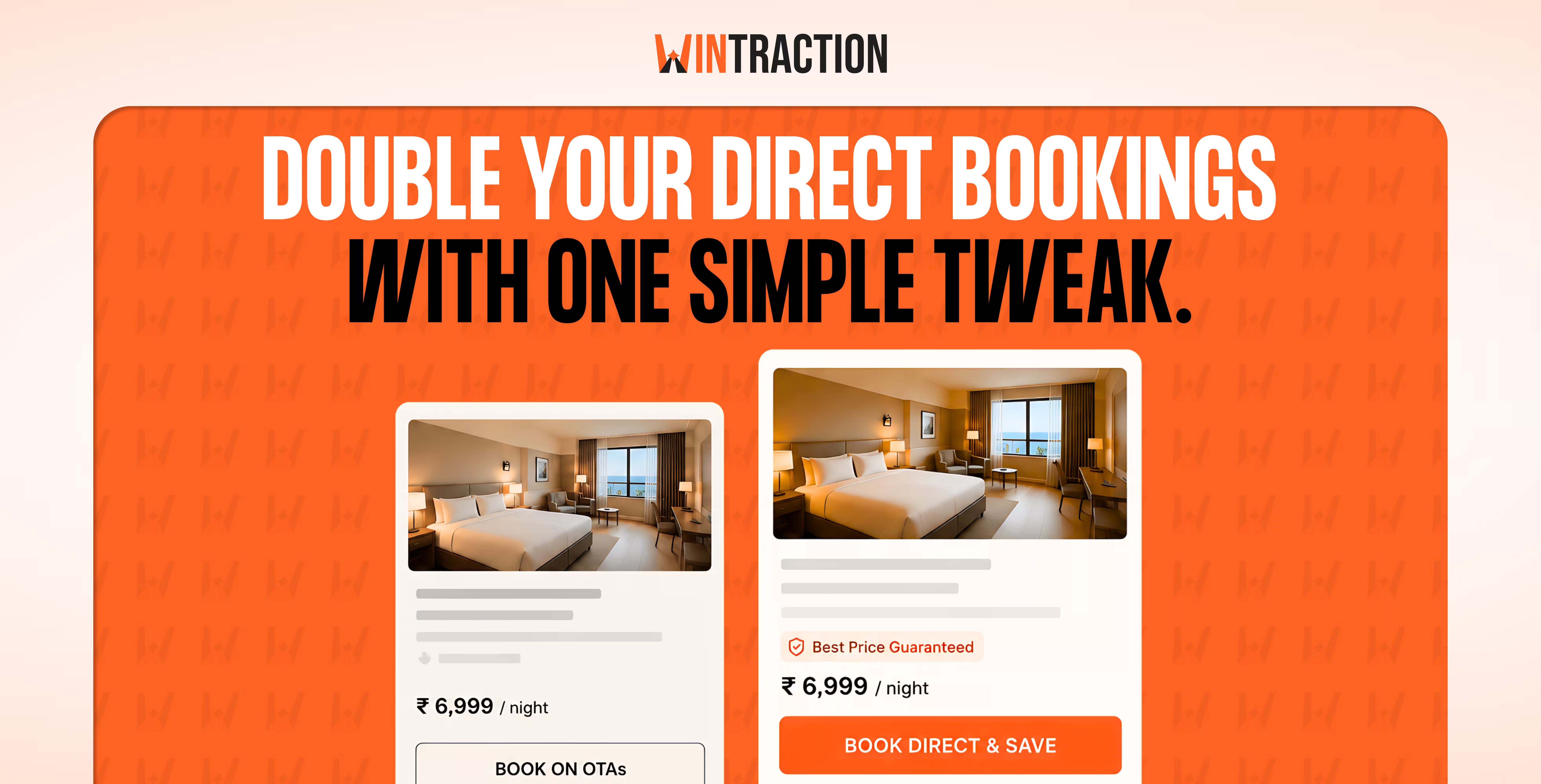
- Show a "Why book direct?" block above or near the rate display.
- Highlight benefits like: best rate guarantee, flexible change or cancellation policies, and exclusive perks (welcome drink, breakfast, parking, room preference, late checkout).
- Keep the message simple, consistent, and present on all critical pages.
You are not trying to undercut OTAs by huge margins. You are making direct feel obviously smarter.
Align offers with how AI is likely to present you
If your content and reviews position you as "best for business near [venue]," you should have a dedicated Business Stay page with early breakfast times, quiet workspaces or desks, Wi-Fi guarantees, distance and transport details, and a Conference Package that clearly bundles these benefits.
Likewise, if you are ideal for families: a Family Stays page and package with kids' beds, breakfast, and local activity tie-ins. This alignment means when AI sends travelers to you as "great for X," your site and offers reinforce that recommendation and capture the booking on your own engine.
Remove friction from the booking process
All the visibility in the world will not help if your booking experience causes drop-offs. Check:
- Mobile experience: can someone search dates and see prices quickly on a phone?
- Transparency: are all fees and taxes visible early in the process?
- Trust: does your booking engine look and feel modern and secure?
- Steps: can a returning guest complete a booking in just a few screens?
Every extra step is an opportunity for travelers to bounce back and re-book through an OTA instead. Even small usability issues often surface during AI visibility and conversion audits because visibility alone does not guarantee revenue.
Step 4: A Simple 90-Day AI Visibility Plan to Lift Direct Bookings
To turn this into reality, work in short, focused cycles.
Month 1: Clarify and Standardize
Goals: Make your hotel legible to AI systems and align your key profiles.
- Rewrite your homepage hero to clearly state where you are, what you are, and who you are best for.
- Update your Google Business Profile and main directories to match that positioning exactly.
- Implement or fix basic hotel structured data so machines can read your core details without guessing.
Month 2: Create Proof and Answers
Goals: Build the review signals and content AI tools reference when recommending you.
- Start systematically requesting reviews with a helpful prompt about trip type and what guests liked.
- Publish two to three high-intent local content pieces that answer common "where should I stay?" and "is this a good area?" questions.
- Add a simple, consistent "Why book direct?" block to your main booking-path pages.
Month 3: Align Offers and Track Impact
Goals: Close the loop between AI discovery and direct revenue, and establish baseline metrics.
- Create or refine at least one direct-only package for each key segment (business, leisure, families).
- Ensure all content and profile links land on pages with clear direct-booking benefits and smooth UX.
- Begin tracking: percentage of bookings that are direct versus OTA, direct bookings coming from organic or unknown referral sources, and revenue from direct versus OTA bookings over the quarter.
You are looking for a steady uptick in direct share and organic origin, not an overnight explosion. The hotels that commit to this for 90 days consistently see meaningful shifts in their booking mix.
Conclusion: Becoming the Obvious Answer for Direct Stays
The simple strategy in this guide is not a clever hack. It is a shift in how you think about visibility. Instead of shouting louder with more ads, you are making it easy for both machines and humans to understand who your hotel is perfect for, when and why they should choose you, and how to book you directly with confidence.
By making your hotel highly visible and trustworthy to AI agents and search systems, then backing that up with clear direct-booking value and a smooth UX, you build a hotel direct bookings strategy that compounds. Most of the people who are already looking for a stay like yours end up on your site, see why direct makes sense, and book with you instead of through a middleman.
To start, you do not need to overhaul everything. Pick one step:
- Clarify your homepage positioning.
- Fix your key profiles.
- Publish one strong, local "where to stay" guide that reflects how you actually serve guests.
Each of these moves makes you a little more visible and a little more recommendable. That is exactly how you 2x your direct bookings over time.
You might already have enough authority to win more direct bookings, but unclear positioning, missing local signals, or weak AI visibility can quietly send those bookings elsewhere.
To understand why showing up inside AI answers matters so much in the first place, read our complete guide to answer engine optimization.