In 2026, the agents who win are the ones who get real estate leads without ads by building systems that attract, nurture, and convert people they did not have to pay for every single time. Instead of renting attention from portals and lead vendors, you build an engine that produces real estate leads online and offline consistently, and on your terms.
This guide walks through seven proven, modern ways to do that, with a bias toward repeatable actions you can build into your week, not one-off hacks.
Executive Summary
How to Get Real Estate Leads Without Ads
Getting real estate leads without ads means treating your business like a media and relationship engine, not just a sales role. Every touchpoint works together to pull the right people toward you:
- Your website, local content, and lead magnets bring in real estate leads online from people who already trust you before they book a call.
- Your sphere, past clients, and local community become an always-on referral and repeat business source.
- Your pipeline belongs to you, not to a platform, and it compounds over time instead of resetting every month.
Turn Your Sphere and Past Clients into a Lead Machine
Most agents sit on the most valuable lead source in the world and barely touch it: their sphere and past clients. The goal is not to ask for business every time. It is to stay visible, helpful, and present so when real estate comes up, your name is automatic.
Clean and segment your existing list
Start with what you already have. Export contacts from your phone, email, CRM, transaction history, and social media. Then tag people into simple groups:
- Past buyers and past sellers.
- Hot prospects (people who have expressed interest but have not transacted yet).
- Friends and family, local professionals, and everyone else.
- Your top 50-100 "A" relationships: the people most likely to send you business.
You are not doing anything complicated yet. You are getting a realistic view of who you can actually talk to.
Build a simple touch system, not a spam system
The aim is steady, light contact, not pressure. Examples of touches that work:
- Quarterly market updates (a short email or message: "Here is what changed in [area] this quarter in three bullet points").
- Personal check-ins ("Saw your neighbourhood in the news, how are things over there?").
- Life event touches: congratulations on work anniversaries, milestones, and birthdays.
- Annual homeiversary notes with updated home values or neighbourhood stats.
Every touchpoint should make their life easier, keep them more informed, or help them feel more connected. It should not just ask for referrals.
Make it easy for them to refer you
People often do not refer because they are not sure how. Fix that by giving them a short, clear sentence they can repeat easily, and a simple shareable link (your calendar, WhatsApp, or a landing page) they can forward when someone mentions buying or selling.
Occasionally, be specific about who you are focusing on: "If you hear anyone talking about real estate this month, feel free to connect us. I am especially focused on first-time buyers and move-up families right now."
Build an Authority Hub to Attract Real Estate Leads Online
Buying leads often feels easier than building a website and content strategy, but it keeps you on the treadmill. An authority hub is your combination of website, local pages, and lead magnets that consistently attracts real estate leads online without ads.
Get the basics of your site right
You do not need a huge site. You need a clear one:
- A strong home page that says who you help, where you operate, and why you are different.
- Core pages: Buy, Sell, About, Neighbourhoods or Areas, and Contact or Book a Call.
- Fast load times and mobile-friendly design, since most people browse on their phones.
- Each page should have one clear headline matching search intent, short scannable sections, and a single main call to action.
Create local landing pages that answer real questions
Instead of generic "We serve the whole city" messaging, build focused pages around specific neighbourhoods or suburbs, property types (condos, townhomes, luxury), and buyer types (first-time buyers, investors, downsizers). On each page, answer:
- What is it like to live here?
- What do homes cost right now?
- Who is this area best for, and what are the trade-offs versus nearby areas?
This kind of content is what modern search and AI-powered tools love to surface, and it converts into real leads when people land there because it answers the specific question they were asking.
Offer one or two strong lead magnets
Instead of ten weak freebies, create one or two strong offers tied to real problems:
- 2026 [Area] Home Buyer Playbook for buyers in your market.
- What Your [Neighbourhood] Home Could Sell For in 2026 for potential sellers.
- Moving from Renting to Owning in [City]: 7 Steps for renters and first-timers.
Gate these with a simple form or a calendar link. People who download them are high-intent, and your follow-up leads with value before it ever asks for a conversation.
Use AI Visibility to Turn Your Online Presence into Recommendations
In 2026, AI platforms like ChatGPT, Gemini, and AI Overviews in Google are quietly becoming a new discovery layer for buyers and sellers. Many people now ask AI tools: "Who are the best agents in [city]?" or "Which realtor should I talk to about selling my home in [area]?" rather than manually comparing dozens of profiles.
To get real estate leads without ads from this new layer, your goal is to become one of the agents AI feels confident enough to recommend.
Understand what AI visibility actually is
AI visibility is the sum of all the signals about you that AI systems can read and verify across the web: your website and local content, your profiles on portals and directories, your reviews and mentions on third-party sites, and your social and video presence. When these signals are clear and consistent, AI tools are more likely to include you when answering real estate questions for your market.
Strengthen the signals AI cares about
You do not need to game AI. You need to make your real-world authority easy for AI to see:
- Make sure your name, locations served, and specialties are described the same way on your site, portals, and social profiles.
- Publish specific, local content that matches the questions people actually ask AI: "Is now a good time to sell in [neighbourhood]?" or "Best areas in [city] for first-time buyers."
- Get mentioned on credible third-party sites: local news, podcasts, and niche blogs as an expert source. AI systems heavily weigh these external citations.
Connect AI visibility back to your no-ads lead engine
The payoff is straightforward: when you invest in AI visibility on top of your website and content work, you create another organic channel of real estate leads online that you did not buy.
- Buyers who ask AI for agent recommendations see your name, visit your site, and come in warm.
- Sellers who research "who is good at selling in [area]" see your content and reviews cited.
- Over time, your share of recommendations compounds, giving you a structural advantage over agents who only compete inside portals and paid ad auctions.
If you want to see how visible you currently are across AI-driven search and recommendation platforms, we offer a free AI Visibility Audit for real estate agents.
Use Video and YouTube as a 24/7 Lead Magnet
Video, especially on YouTube, is one of the fastest ways to get real estate leads without ads because it builds trust at scale. People feel like they know you before they ever speak to you.
Make videos for specific people, not for everyone
Instead of broad real estate tips, go narrow and local:
- Buying Your First Home in [City]: What I Would Do in 2026.
- Living in [Neighbourhood]: Pros, Cons, and Realistic Costs.
- Selling a Townhome in [Area]: 5 Things No One Tells You.
Think about your best current or ideal clients and answer the questions they actually asked you in real conversations.
Use a simple, repeatable video structure
You do not need high-end production. You need clarity. A simple format that works:
- Hook: state the problem or question in plain language in the first 15 seconds.
- Context: who this video is for and what you will cover.
- Content: three to five clear points, each with a specific, local example.
- Call to action: invite viewers to download a guide, schedule a call, or message you directly.
Every video description should include your name, market, and a short "who I help" sentence, a link to your main lead magnet or calendar booking page, and key local phrases that match what your audience searches for.
Repurpose video into other content
One good 10-minute video can become a blog post on your site, short clips for social media, snippets for email newsletters, and clips for follow-up sequences in your CRM. This is how you build a content system that keeps working long after you press publish.
Turn Social Media and Communities into Conversation Funnels
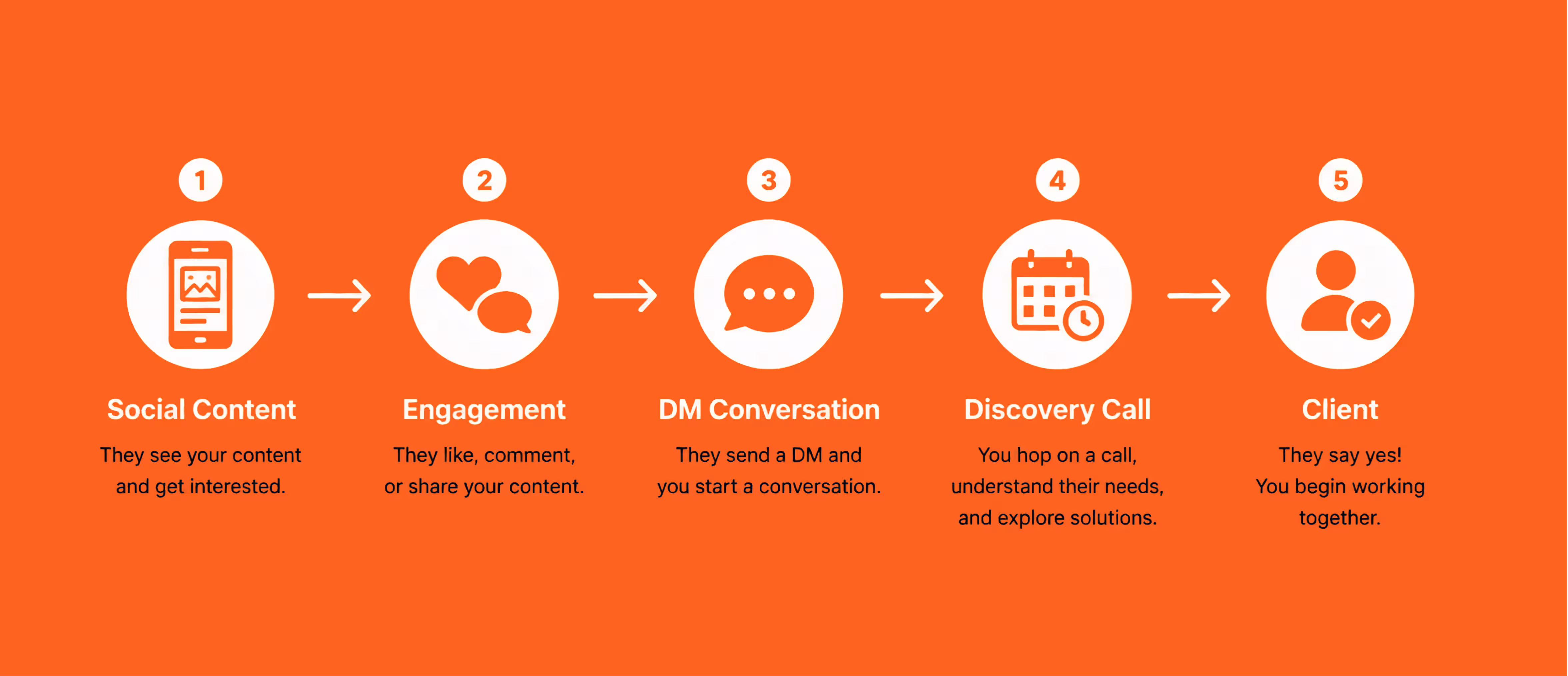
Social media alone does not guarantee leads. The goal is to start conversations with the right people, then guide those conversations off-platform and into a call or direct message exchange.
Shift from posting for reach to posting for conversations
Post types that actually move people:
- Specific local angles: "Three streets in [area] where houses sell fastest and why."
- Opinion questions: "Would you move to [neighbourhood] if it meant a 30-minute commute each way?"
- Real client stories (with details changed): the problem, the options considered, and the outcome.
Posts that do not work: motivational quotes with no context, generic "just sold" posts without insight into how or why, and walls of text with no clear point or call to action.
On each post, ask yourself: what is the one action I want someone to take? (comment, message, click, or share).
Use direct messages intentionally
Direct messages work when they are earned, not blasted. A good flow:
- Someone engages with your post or story.
- You reply with something specific: "Saw your comment about moving for schools, what age are your kids?"
- You ask questions and show genuine curiosity, not business intent.
- Only when there is a real need do you say: "If you would like, I can walk you through what this could look like in [your area]. Want to jump on a quick call?"
Show up where your people actually are
Beyond mainstream platforms, consider local Facebook groups (neighbourhood forums, parenting groups, relocation groups), WhatsApp or Telegram communities, and niche forums for investors or specific professions. You are not there to pitch. You are there to answer questions, add perspective, and be the person who clearly knows what they are talking about.
Win Leads from FSBOs, Expireds, and Local Data (Without Being Spammy)
FSBOs and expired listings are often approached badly. Done right, they can be consistent, no-ad-cost sources of serious leads. The key is changing your frame entirely.
Change the frame: from "I want your listing" to "I can solve your problem"
FSBOs and expired sellers are usually frustrated, skeptical of agents, and already overloaded with generic scripts. If you come in like everyone else, you will be ignored. Instead:
- Acknowledge their experience: "Looks like you tried selling on your own first. That is not easy."
- Ask what they were hoping for, and what actually happened.
- Offer specific, bounded help rather than a pitch: "If you would like, I can show you why buyers might be passing on this and what two or three options you realistically have now."
Create a simple property diagnosis offer
Offer a mini audit covering pricing versus local comparables, how the listing looks online (photos, description, platform mix), and what buyers in the area actually value right now. You can deliver this as a short call, a recorded video walkthrough, or a one-page PDF with bullet points. The key is: you demonstrate expertise before asking for a listing.
Use local data and public records smartly
Depending on your market, you can often identify owners of properties that fit your ideal criteria by age of ownership or property type, and watch for life-event signals (downsizing, upsizing, inheritance). Reach out with context ("I specialise in homes like yours in [area]"), with value ("Here is what I am seeing with similar properties today"), and with permission ("If it is helpful, I can run a quick valuation or show you scenarios for the next two to three years").
Build Referral Partnerships That Send You Warm Leads
Some of the best real estate leads online and offline come from professionals who see your ideal clients before you do. These are warm introductions from trusted sources, which means conversion rates are far higher than cold channels.
Identify three to five ideal partner types
Think beyond other agents:
- Mortgage brokers and loan officers (they speak to buyers before anyone else does).
- Financial planners and wealth managers (clients approaching major life transitions).
- Divorce attorneys or family lawyers (life changes that often include a property move).
- Accountants and tax advisors (investors and business owners making property decisions).
- HR leaders at companies that relocate staff (a consistent, predictable source of movers).
Make partnerships a two-way, structured relationship
Instead of a simple "send me leads" ask, think in terms of shared value:
- Co-create content: webinars, guides, or live Q&A sessions that showcase both of your expertise.
- Agree on mutual referral criteria and how you will handle introductions.
- Share anonymised market insights that help them look knowledgeable with their own clients.
The goal is to become part of their service, not just a name on a list. When their clients mention moving, your name should come up automatically.
Make it easy for partners to refer you
Give them a simple one-liner that describes who you serve: "families moving from city apartments to suburbs in [region]." Provide a short, professional overview page or PDF they can send to clients. Offer a quick, no-pressure review call where you simply help their clients understand their options without any obligation.
90-Day Action Plan to Replace Paid Ads with Organic Lead Flow
Without a timeline, this all becomes a list of good intentions. Here is how to build your no-ads system in three months.
Month 1: Foundations and Sphere
Goals: Clean your list, fix your online presence, and start showing up consistently.
- Clean and segment your contact list. Identify your top 50-100 "A" relationships.
- Start a simple touch plan: weekly or bi-weekly check-ins and one market update per quarter.
- Fix the basics of your website: clear who you help, where you work, and one strong call to action per page.
- Optimise your Google profile and main social bios to clearly state who you help and where.
Month 2: Content and Conversation
Goals: Start creating authority content and meaningful conversations.
- Create two to three core authority pieces (local guides, buyer or seller playbooks) and publish them on your site.
- Launch your first three to five video topics answering specific, local questions your clients actually ask.
- Start posting three to four times per week on your main platform with conversation-oriented content.
- Engage in two to three local or niche communities, focusing on answering questions rather than pitching.
Month 3: Partnerships and Advanced Plays
Goals: Activate referral channels and build in measurement habits.
- Reach out to three to five potential referral partners and set up introductory conversations.
- Design a simple property diagnosis or option review offer for FSBOs and expired sellers.
- Build a basic nurture sequence for new online leads: three to five messages or emails over two to three weeks.
- Review your numbers: new conversations started, calls booked, and deals sourced from organic channels.
Your goal in 90 days is not to unplug all ads immediately. It is to prove to yourself that you can start meaningful conversations and win clients without paying per lead. Once you see that working, scaling it becomes straightforward.
Common Mistakes Agents Make When They Stop Buying Leads
Expecting instant volume
Paid ads can turn on lead volume quickly, even if the quality is low. Organic systems build more slowly, but they last and compound. Do not judge the strategy by the first two weeks. Give it 90 days before drawing conclusions.
Doing a bit of everything with no depth
Publishing one video, one blog post, and a few social posts will not move the needle. Pick one or two main channels (YouTube and email, or blog and Instagram) and go deep for 90 days. Breadth without depth produces nothing measurable.
Talking like a marketer instead of a human
Generic content ("We care deeply about our clients" or "We provide exceptional service") blends into the noise. Be specific, local, and honest about trade-offs and realities. That is what makes people trust you enough to reach out. The agents who win organically are the ones who sound like a knowledgeable neighbour, not a marketing brochure.
Conclusion: From Lead Buyer to Demand Creator
If you have read this far, you have already taken a step most agents never do: you have stopped asking "Where can I buy more leads?" and started asking "How can I create real demand for my expertise?"
You have seen that:
- You can get real estate leads without ads by taking your sphere seriously, not as an afterthought.
- An authority hub of website, local pages, and focused content can bring you real estate leads online from people who already trust you before they book a call.
- Video, social media, communities, FSBOs, expired sellers, and referral partners can all become predictable, low-cost sources of clients when you approach them with empathy and systems.
- AI visibility is an additional organic channel that compounds the value of everything else you are already building.
A 90-day plan is enough to see the first real signs that you do not have to rent every lead forever.
The real win is not just saving ad spend. It is building a business where your calendar is filled by people who already know why they want you, not just any agent who answered an internet form.
The agents who thrive long term will not be the ones with the biggest ad budgets. They will be the ones who own the relationship before the conversation even starts.